❓ Q&A Guide
Factual Questions
Q1: What is the first topic the instructor covers in the calculus class? A: The first topic is a review of basic algebra concepts, starting with section 0.1, chapter zero, which discusses lines.
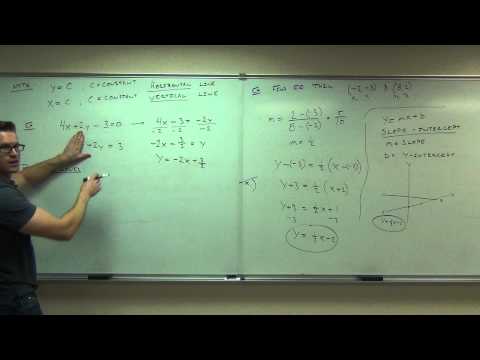
Q2: How many points are needed to graph a line according to the instructor? A: Two points are needed to graph a line.
Q3: What formula does the instructor derive for finding the slope of a line? A: The instructor derives the slope formula ( \frac{y_2 - y_1}{x_2 - x_1} ).
Q4: How does the instructor suggest differentiating between two points on a line? A: By labeling them as ((x_1, y_1)) and ((x_2, y_2)).
Conceptual Questions
Q5: Why is it important to understand the slope formula for calculus? A: Understanding the slope formula is important because it is foundational for concepts in calculus, such as derivatives and the behavior of functions.
Q6: What does the term "point-slope form" refer to in the context of equations of lines? A: Point-slope form refers to the equation ( y - y_1 = m(x - x_1) ), which is derived by fixing one point and using the slope to express the line's equation.
Analytical Questions
Q7: How can you derive the slope-intercept form from the point-slope form of a line's equation? A: Starting from ( y - y_1 = m(x - x_1) ), you can distribute ( m ) and then add ( y_1 ) to both sides to get ( y = mx + (y_1 - mx_1) ). This simplifies to ( y = mx + b ), where ( b = y_1 - mx_1 ).
Q8: How can the concept of the angle of inclination be related to the slope of a line? A: The angle of inclination, ( \theta ), of a line is related to the slope, ( m ), by the equation ( m = \tan(\theta) ). This means the slope of a line is the tangent of the angle it makes with the x-axis.
Application Questions
Q9: If you are given two points ((3, 4)) and ((6, 8)), how would you find the slope of the line passing through them? A: Using the slope formula ( \frac{y_2 - y_1}{x_2 - x_1} ), plug in the points: ( \frac{8 - 4}{6 - 3} = \frac{4}{3} ). So, the slope is ( \frac{4}{3} ).
Q10: How would you find the equation of a line that is parallel to ( y = 2x + 1 ) and passes through the point ((4, -3))? A: Since parallel lines have the same slope, the slope ( m ) is 2. Using the point-slope form: ( y + 3 = 2(x - 4) ). Simplifying, ( y + 3 = 2x - 8 ), and ( y = 2x - 11 ).
Extension Questions
Q11: How would you find the equation of a line that is perpendicular to ( y = \frac{1}{2}x + 3 ) and passes through the point ((2, -1))? A: Perpendicular lines have slopes that are negative reciprocals. The slope of the given line is ( \frac{1}{2} ), so the perpendicular slope is ( -2 ). Using the point-slope form: ( y + 1 = -2(x - 2) ). Simplifying, ( y + 1 = -2x + 4 ), and ( y = -2x + 3 ).
Q12: How can you use the unit circle to find the tangent of an angle, and why is this important for calculus? A: The unit circle helps find the tangent of an angle by providing the sine and cosine values, where ( \tan(\theta) = \frac{\sin(\theta)}{\cos(\theta)} ). This is important in calculus for understanding the behavior of trigonometric functions and their derivatives.